Friday, February 21, 2020

Back to the Clowns

A busy day of actual art yesterday. I'm reminded how much time I seem to spend on admin or procrastinating... yet this tends to be proactive procrastinating, that is, working on something that will help something else, while unconsciously working.

However, yesterday was was one of creative work. I made the preliminary music for Lost at the Fair and The Knife Thrower. I'm not happy with either. The knife thrower track has a gentle, romantic feeling, like Barefoot, or She Floats, or some of the other tracks we've done; gentle piano with strings. This suits the mood of the poem, although the pacing is wrong. With a song, the pace of the vocals is set by the melody, but with a poem, the pacing can be anything, but it needs to dialogue with the music. This interplay makes the whole recording and production process extra challenging, but fun; the possibilities are greater.

The pacing is easily fixed, but I'm a little bored by the sameness of the track to others that we have done. It's odd; I used to wonder why Genesis didn't make ten more albums like Foxtrot, as I liked Foxtrot and wanted more like that. They felt the need to move on though. Now I feel the need for newness too. However, mood is mood, so I'll tweak things a little and probably keep Knife Thrower as it is.

Lost at the Fair is more complex and difficult. It's one of my favourite poems with a double meaning about losing ones mother to dementia (or something else). It's subsumed with emotion and so one of the most difficult. The imagery of being in a blur of a fairground is easy to conjure, however. This one must be right.

Other jobs today:

First, emails. I'm part of three performances this year it seems and we'll probably do something at Crewe Library in March or April. I want to help with local arts as much as I can too, and will certainly take part in a major way in the Crewe Storyfest in July. I've also listed the Facebook event for the next live ArtSwarm event, and spent at least an hour fixing a long term hardware problem on my PC, getting it to re-detect my Lexicon Alpha after awakening the computer; this involves a DEVCON command (sounds like a nuclear war controller, it is, instead, a command line version of the Device Manager).

This afternoon I finally, tada, submitted Burn of God for publication. I made on last minute change to the music, some stark breaths after the Skeletons track; an awakening from the nightmare. This is one of the most arresting parts on the arresting album. I also tweaked the album artwork, after receiving the new War is Over discs, which look amazingly good, some of the best graphics I've worked on so far.

I've also spent a good 45 minutes today playing electric guitar along to Amarok, the Mike Oldfield album, and the classic Starfleet Project E.P., which is perfect for jamming to (if you want to jam with Brian May and Eddie van Halen).
Wednesday, February 19, 2020

Reverb Recoding

We went to an inspiring poetry reading last night in Crewe library, and heard new poet Lenni Sanders who had a captivating performance style, and imaginative output and use of language. Afterwards we drank champagne infused with Pixley Berries blackcurrant cordial, which was exquisite, and watched No-Man's Land, the Harold Pinter play, on television via YouTube. Only a fez and quilted smoking jacket could have made the night more perfect. Maybe I could wear them to future poetry nights!

We may have a Fall in Green gig at Crewe Library in the coming months.

Reprogrammed all of my reverb plugins today. The bug in them wasn't serious, but, given a long silence, could have pushed some floating point values beyond their limits. My reverbs are:

Oxyverb: a plain (6-channel) reverb with Left/Right stereo delay. The delay has a degree of softness which can be adjusted. Nitroverb: like Oxyverb but the delay has feedback. This can create immense space, it's the one used on the original Flatspace theme. Hydroverb: Like Oxyverb but includes a band pass filter rather than low pass on the reverb tail. Gives a lighter sound. Simple Reverb: A quick, plain, monophonic reverb. This is very fast to process and useful for things like snare drums or special effects or instruments that could use a smoothed out sort of sound. Kryptoverb: Like Oxyverb, but is monophonic. You can specify how much information from each channel is selected for the mix. Ironverb: A very tinny, plate-style reverb with a band pass filter. Good for robotic speech effects.

I also have Oxyverb II, Nitroverb II, and Hydroverb II, which have 6-channel delays. All reverbs operate in 6-channels anyway, for full 3D sound in each axis; rarely used, but at least I have the functionality. I can produce a 5.1 mix of any of my tracks automatically, if I ever needed one. I really must program in some sort of ambisonic exporter one day. These 'II' plug-ins allow customisation of the shape in each channel. Oxyverb II and Nitroverb II also feature high and low pass filters on the reverb tail.

All of the reverbs use a decay which can extend to infinity if required; so you can 'play' the breathy reverb tail if needed, or fade it to a custom shape as needed. My aim is functionality and efficiency, nothing too complex, too much or too little.

Every parameter of every plug-in I use can be modulated; either using an L.F.O. style modulator, like something simple like a sine wave, although these are just wav files, so any pattern can be used and/or looped if needed. You can also trigger, attach, or detach a modulator inside a sequence, or set a parameter inside a sequence, or fade from one to another. This power means that every act in a song can be really quickly and efficiently automated. Even fundamental operations, like the total song mix volume or song tempo are standard plug-ins, which use the same system and can be modulated in this way.

Next, I must update The Burning Circus and move on. I feel as though the year is wasted on wrestling with Burn of God. The project evokes the spirit of Wings, the Howard Hughes behemoth which gave him so much trouble.

Tuesday, February 18, 2020

Birthday and Reverbs

A break yesterday to celebrate Deb's birthday, a full day with trips to Congleton and Sandbach and more.

I really wanted to get some creative work done but felt unable, still too tired from the weekend. I pressed another draft of Burn of God. I will keep listening repeatedly until I'm happy with it several times in row, then it is done.

I've toyed with the idea of adding a high pass filter to my reverbs, and then realised that a potentially faulty volume tracker is present in the code, this means that I must recode all of the reverb effects, so I might as well add that filter. This should really clear up my future mixes.

Also today, some new guitar picks arrived, which are the best I've tried, renowned picks; Jim Dunlop Jazz IIIs. These are excellent for note picking, thicker and pointed to a bevel like an arrowhead, and polished there to be very smooth. I have a frosted yellow one with a slightly rougher texture too, and they're smaller than normal, which is good because your fingers are closer to the strings. Not so good for strumming though. I find scales a easier with them, but I'm only just beginning here.

I cleared a page to start a painting, but haven't got further. I'll probably spend tomorrow coding these reverbs. Such a frustrating few months, I have so much to create yet feel blocked at times; yet I've learned a great dead about music engineering and have programmed some very useful new plugins. I must push on, life is short.

Tonight, poetry at Crewe library. We may pursue a performance there.

Sunday, February 16, 2020

ArtSwarm Felines

A good ArtSwarm night last night. Spent most of yesterday preparing. I always think it would take hardly any time but it ends up taking almost all of the day. I ate just before leaving but was still starving and exhausted at the end of it, too tired to sleep after carrying the equipment up and down the stairs. After I've survived, I consider it a great workout.

A very good night, a huge mix of acts including poetry, story, and play readings, to songs, music without words, and a projected slideshow. Our most eclectic night yet. These nights are so hard to judge, the acts, the 'quality' of them, is very subjective, and part of the aim of this is for performers to learn and refine their own skills, so everything that takes place is equally good (except, from my point of view as emmcee, acts which overrun or avariciously grasp at shared resources. This is very rare, in fact, I think of the 60 or so acts over 6 events to date, only one has overrun their allotted time). I like to try new things and, if anything, gain most from things which are rough and flawed. We can't learn from things that go to plan. It's public practice of the new that this sort of event is exactly for.

Generally, I feel elated and uplifted at the end, as well as shaky and aching, and often annoyed, worried, exhausted, wondering why I do them and if I should continue. At the end of each one I tell myself that it was the last one, that I can't face another. Not due to any treatment by anyone else; Deborah, performers, and audience alike are hugely supportive and positive to an amazing degree, but these events are draining physically and emotionally, and can feel unrewarding and relentless. Yet, perhaps that is the essence of art itself, and the essence of life too. The essence of art and life is the pursuit of crazy, seemingly meaningless, excessive and tiring explosions of expression; climbing a mountain in a storm, raging against the wind, smashing the walls with fists and warrior's cries. This is the romantic ideal. As such, perhaps this feeling itself proves that these ArtSwarm events are indeed art, moreso than the ArtsLab on the radio, moreso than ArtSwarm the YouTube show.

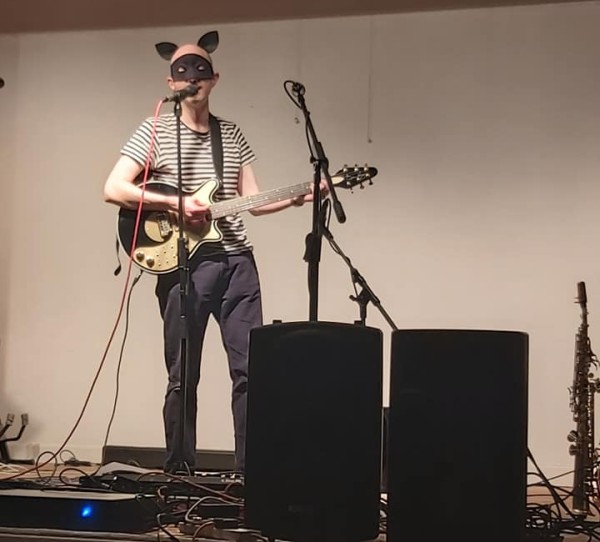
Here I am as 'Ttom Catt' singing Let's Dance Little Squirrel. I rehearsed it a minuscule three or so times, yet discovered on the night that my mask made seeing what I was playing impossible, so the performance turned into a surrealistic punk performance. I am sure that this made it better, turned a mere rock song into an transdimensional emotional orb.

Little squirrel...
Hey, little squirrel...

Let's dance
little squirrel
Let's dance
to-night

Take a chance
little squirrel
I will not
bite

Ready or not I'm coming
My heart is beating fast
I feel my eyes dilating
wide
and you are in my sight.

Little squirrel!
Little squirrel!

Let's dance
little squirrel
Let me have a
taste

Try your luck
little squirrel
there's no time to
waste.

Ready or not I'm coming
My heart is beating fast
I feel my eyes dilating
wide
and you are in my sight.

Little squirrel!
Little squirrel!

Friday, February 14, 2020

More Burn and ArtSwarm

Back to tweaking Burn of God today. I've only made seemingly changes to the vocal and bass balancing but I'm so much more pleased with the music now. Things are never perfect but it must be at least artistically sound. I must at least feel happy with the result.

I programmed a new Fuzz Compression effect too, a replacement for an existing one. For actual compression it's not very useful because it invariably produces distorting artifacts, but sometimes this sounds rather good, like a warm fuzziness, ideal for bass sounds, or odd vocals, or smooth strings, or other special effects. My code had an error with the powf(x,y) command. I'd assumed that when x=0, the result would be zero, but sometimes it could be infinity, or cause other sillyness.

A busy day otherwise with arranging future engagements: plans for the Crewe Story Festival, and thoughts about organising other events, two performances, and a request for a new ekphrastic painting for a second exhibition at Stockport War Memorial Art Gallery, after a successful exhibition last year. They want a painting delivered by March 1st; a tall order given that it would take at least 10 days to dry, never mind composition and painting. Ideally I need a minimum of 4 months to develop a painting... although I'm reminded that last year I rushed through three to good effect (although only in one layer, and the paintings were barely dry).

With the new Apocalypse of Clowns album, and a second Marius Fate album as targets before the end of March, possibly two festivals to help organise, and one to take part in, the year is shaping up to be busy, which I like.

Tomorrow it's the live Cirque du ArtSwarm: Felines event. A huge storm is forecast. I recall that heavy rain arrived on two of the five ArtSwarm night last year. This does put off visitors. I typically dislike every aspect of these performances, primarily the exhausting physical work of carrying equipment, setting up, welcoming, hosting, and performing; yet I generally feel elated after them. I am reminded that one of Leonardo da Vinci's main jobs was organising court entertainments. This time, I am looking forward to it. We have ten acts of 10 minutes, some of which feature first time performers, and everything on the billing is very eclectic. Doors open to the public tomorrow at 18:30.

Thursday, February 13, 2020

Bugs and the Madness of Perfectionism

I remained unhappy today, due to Burn of God, I just wasn't quite happy with the quality of the music, specifically the balancing of some of the tracks. At 3pm or so, I pulled the release and instantly felt much better. Perhaps I made the mistake of discovering a new fancy audio effect, tweaking my sounds with it and instantly accepting the results.

I've also discovered some bugs in my recent audio plugins. This is actually an old bug, but one that rarely appears. The volume of the signal is tracked by a floating point value, multiplying it by a fraction to reduce it, or by the inverse of a fraction to increase it. The thing is, sooner or later this will reach a limit of infinitesimality which causes the vales metaphorically explode and ruin the audio (and program generally). I merely needed to add limits to the value (curiously, this speeded up the algorithms rather than slowed them). This only occurs after about a minute of silent audio or so, but would apply to any of my plugins that use volume trackers, including noise gates. It feels good to find a bug like this, even if I'm the only one who would ever notice or appreciate it. This is the eternal sadness of the programmer; the reason I wanted to become an artist instead.

I surmise that nature will have the problem of infinitesimal amounts too. You can only divide so many times before a limit is reached, thus quantum mechanics. Nothing in the universe is actually infinite, even in maths its only a theoretical idea; we can never count to infinity for example, or, for that matter experience zero.

I've developed a few new plugins; a new noise gate, and an "Engram Input Attenuator". Engrams are ways of passing track data to another track, like a parallel data feed. In this case, I can use that data to 'duck out' a track. It's rarely useful, but can be used for some interesting effects. If I use the drums as an input, and apply it to a steady bass then the bass will hop and jump in the gaps between the drum sounds, very groovy for fans of nineties bands like 'Sash'.

I've also ordered the War is Over CDs today. I still, however, feel unproductive today, and anxious about this bug. These plugins, with their 6-tracks and lots of complex variables, all seen and monitored by hand, are easy to accidentally spook. I'll have to check the others in case any other use volume trackers. I don't think any do...

Wednesday, February 12, 2020

Admin and Noise Gates

A couple of days of music admin. First, tada! Burn of God is complete. I've had enough of tweaks this way and that. I have mixed feelings about it today, at times liking everything and seeing it, for the most part, as the artwork I envisaged, an exploration of a subject in a way rare for music, something Bergmanian, dramatic, and different. At other times I dislike it, but then see it as a transition album. It has many firsts; it's my first album where almost all of the tracks include sung vocals. The majority of my music has been instrumental to date, but now, I can't imagine going back to that, or to something easy.

It's also my first album which includes live guitar, though I can barely play a note on the instrument. This month I've started to practice guitar, though. Learning any instrument is a matter of commitment, to learn it or die! No grey areas or limp ideals! All artists should be learning new skills as well as showcasing existing ones.

I've heard today that War is Over is also complete and has started to appear on platforms like Google Play, and we have some important Fall in Green performances booked for this year. I'd like to do something special with the Apocalypse of Clowns album, and create something rounded and complete, with a psychological dimension, like my Burning Circus collection. I wonder if we could create something fantastical, like a classic Genesis or Marillion album. The challenge with fantasy is making something that people feel is about them, but that's the challenge of realism too.

Another thing I've done today is work on a new noise gate algorithm based on my compressor code. My existing gate uses a volume tracker of fixed intensity, and when this goes below the threshold, fades the sound out by a certain 'decay' slope, and when above, fades it up by a certain 'attack' slope. My new one uses separate attack and decay slopes for the volume tracker, but a fixed 'bite' for the gate. One difference is that I can adjust the relative volume of the gated and ungated bits, even amplifying or inverting the signal of either to create odd effects. It's an experiment. I'm unsure if this new 'Hypergate' will be useful at all. I hardly ever use noise gates, only really for special effects (gated reverbs perhaps, and I can put them in parallel with a second track, to so-called 'duck' a mix, even then, very rarely, the need for a duck is a sign of bad composition).

Here's the final Burn of God cover. It will be out on March 20th.

Monday, February 10, 2020

Band Wire Compression

Compression victory! I've fixed up my new compression algorithm and it's instantly improved things. I rarely use any E.Q. or compression; for me, these are attempts to repair composition problems (what I mean is, I design instruments to fill those gaps rather than use the wrong instrument and then try to adjust it).

But sometimes these things can be vital, particularly for bass and vocals. Bass because changes in the note itself can audibly change the volume, anything filtered will make the higher notes literally quieter, and electronic bass sounds in particular often use low pass filters, and all mics have variable frequency peaks.

What I wanted to try was a tool to compress a specific frequency range, like a band-pass filter and compressor, remixed into the original signal, so I've programmed that today and it's produced good results already. It also creates some interesting soft and fuzzy distortion effects if desired. This weird analogue sounding compression doesn't seem to be like other compressors; changes in the tracking parameters (attack, release) transform the output level dramatically because its directly related, rather than merely using this tracker as a gate sensor. This is a good thing, it can produce interesting sound effects, and all parameters can be controlled to pull anything back (or push it forward) as needed anyway.

In the end I've used two volume tracers; one plain one which gradually (you can adjust the sluggishness) follows the sound wave. A second one will dip to zero when below the threshold value and climb to one when above it. That is used to feed through the compressed signal, and (inversely) feed through the dry data when below the threshold. The original signal is simply divided by the inverse of the first volume tracer. Everything can be phase inverted if desired, although that's probably not useful. The strength of the total effect faded away too, if you wanted just a touch of it.

The new effect which I call Band Wire Compression is a compressor, noise gate (you can switch off compression and just have the gate if you wanted staccato effects), distortion pedal, and a band-pass or peaking filter (as desired).

This work made me think that some music practices are outdated now. Compression can be used to even out a drum kit, or even out the loud/soft bits of a performance but for electronic instruments, digital music is often too even and needs roughening up, if anything. The Marius Fate album was my first to benefit from deliberate variations in intensity so that no note was the same twice, making it sound more human. The compress such things would be a backwards step.

Now, to move on. Already a busy day. Nick Mee came to visit, and tonight it's poetry night in Nantwich, although I'm unsure if I can make it there. I might find or write a poem on the subject anyway.