Thursday, February 10, 2022

Burn of God Mastering

A slow start this morning, but a fast afternoon. Managed, with the help of the new and increasingly fantastic Prometheus, to remaster the new Burn of God tracks. I'm reminded how much work I put into the album. My design notes began thus:

-All experiences are transient a change of flow, like passing through a pane of fog, a drape of emotion.
-Life is as transient as music. We may think we can capture it and record it, but the recording is a dead facsimile, a shop dummy.
-No authentic priest can be an aritst too, to be an artist is to scream at the void.
-The inevitable gravitation towards perfection and infinity.
-Entering the hallway of Oz, the powerful being on infinity, purity, to which we aspire.
-You must face the chasm and accept it - there is no infinity. What of destiny, determinism? Is free will to be hoped for? Is god freewill?
-"interested in the human drama surrounding another human being who really was in the process of slipping away".
-The duplicitous doubt of the priest.

The first draft had four sections but went through many iterations. The album is now largely complete. I will have some new CDs made, but use the existing, first edition, artwork for the first batch at least. As with all of my music, I tend to tweak the album artwork with each issue of 50, making each edition a collector's item, which is why some of my CDs regularly sell for over £30 on eBay. There is more to do. I must develop Spotify Canvases for these, and I might start to make full-screen Argus videos for my music. Many of these tracks are very good, as are the Heart of Snow tracks. I really need a film unit to make videos for them. I need videos for everything.

Regarding the previous post, I will not be demonstrating in the park. If I were to invite an artist to demonstrate their craft, read, or perform, I would, at very least, treat them as special, honoured, and with respect, and would not dream of asking them to come to a park for a day, stand outside for 10 hours without any protection from the elements, not even a chair, expect them to pay for insurance, perform a health a safety check, and leave without payment or compensation.

I will, however, aim to do something on that royal day. God Save the Queen!

Book Posting, Argus, Jubilee

Posted off the replacement Neorenaissance books yesterday, finalised the archiving for Heart of Snow and looked into potential release dates; should I make a plan for this? How? What should it include? I then updated my animation software Argus with 5 or 6 little changes and bug fixes. I've thought that it should be fairly quick and easy to make an animated music video using it for every new song of mine, with a similar look to the Spotify Canvases. Is this worth doing? I seem to be faced with lots of cost vs. reward balance questions.

I received an email from the Friends of Queen's Park about a the Queen's Platinum Jubilee in June, whether I would like to demonstrate art. I had fun painting there at a previous event, Picnic in the Park in 2015:

This time these is no gazebo, tent or covering, so we are subject to the weather's whims. I'll need to buy public liability insurance, £50 or so, and be there from 10:00 to 18:30, setting up from 8am. Fun though painting is, this is a lot of work for nothing except that thing artists often work for, 'promotion', 'publicity', rather than money or anything tangible. I have little to no chance of selling a painting, even if I brought a stock of paintings to display - which I can't, because there are no display facilities other than the grassy floor or floor-standing easels which I must bring myself (and don't have).

Still, Picnic in the Park was enjoyable, and I sold the painting I painted there on that day - though that large canvas (I use the term canvas loosely, the cloth was closer to a bed-sheet) was given to me by Carol Wilkinson of The Cubby Hole. It is part of an artist's job to show their art; and what alternative activities might I do on that day?

Tuesday, February 08, 2022

Visual Studio Registration, CD Art, Macc Art Collection

Started the day gloriously fixing a problem with Visual Studio which wouldn't let me register to use it - despite it being the free 'Community' edition. One of those annoyingly Microsoft-only problems, like Windows Update bugs, that had the danger of incapacitating the system for no reason, but a few Windows Registry keys later and I had, magically and amazingly, fixed this.

I then added a feature to Prometheus to auto-equate the two volume levels of two spectra, such that the spectrum shows the differences between the waves' EQ, rather than volume. Then I finalised the Heart of Snow artwork. Here is the cover:

I completed the rear and CD-surface art, and deleted the recorded audio. The final audio is present in my sequences, it's useful to have a copy elsewhere when working, but at the end of a project, not efficient to keep it all.

Then a trip to the Macc Art Lounge to collect work from the Winter Exhibition. I've been offered the opportunity to exhibit regularly there for at least a year.

I am reminded that things and choices which seem important and worrysome are often trivial. I hear the drums of destiny and feel that my art is still improving, charging forwards like a team of white horses.

Monday, February 07, 2022

Community Art, Heart Of Snow Canvases

I've never made community art. Isn't the phrase an oxymoron? The only exception is art which involves participation; a performance or an event. For actual artworks, even the best 'art by committee' is good only in transience because that which is new is necessarily unpopular.

I say this in response to a comment that no artists today work in isolation, to enhance their craft, self and world through art, though I do, and many of the best artists I know do. Of course, like me, these remain generally obscure, rarely sell work, though it is usually the very best of art by the very best of artists. I receive and fulfil commissions, from people who like my style and want something similar. I can, of course, paint any portrait or pet, but I never get asked to paint a 'normal' painting. I could compose a tune, symphony, poem or novel, or restore an old master or repair just about anything, but people don't ask me for such things, though perhaps one day they will.

A very good day today, and a sleepful night. I dreamt of a world where the portals from my novel The Many Beautiful Worlds of Death were trapping people in strange places, perhaps myself. I think the woman from Stargate SG-1 was in the dream. I may have been trapped, or trying to rescue someone. The dream made me think about love, death, heaven, and other things.

The day has been productive. I've completed the Spotify Canvases for Heart of Snow. I used some images from the album art, and generally a smoky or somehow delicately animated background.

Otesanek here quakes alarmingly:

Bleak Forest has some wonderful drifty snowflakes, the magic of Argus. I made them appear at random places, random sizes, and they wobble left to right in a sine wave, and down as they fade. It all looks rather magical.

I've also finally balanced Heart of Snow, yet again. This album has take two weeks just to balance and master, far longer than any album before... partly because I refused to balance the audio of an album, but now I can see the artistic unity that this can impart to an album. It's amazing how whole albums differ in feeling of EQ. Kimono My House has such a bass-heavy feel to all of it, very 70s rock, yet in comparison to the glassy and glitzy Kick Inside.

I've made the final changes to v2.77 of Prometheus, so now I can save and load EQ profiles. There are few other changes. I may update Argus too, after today's canvas work. Bless my programming genius! Like J.F. Sebastian I am awash with A.I. friends to populate my steel and orange fortress of solitude.

But art is my life, commitment, solemn calling. Heart of Snow won't be released for months, until the appropriate winter, but Burn of God should be ready fairy soon; this is my next job. Secret Electric Sorcery is due out soon, but that was very much a learning album for me, a stepping stone to the greater things to come this year.

Sunday, February 06, 2022

Stanley Spencer's Ghost, Phasers

Another sleepless night, full of energy and loose electricity. Stanley Spencer's electrical aura fills the room, the ghost of an artist struggling in life, to realise great success after death, like most artists. People like dead heroes, they've beaten them, so are free to praise them without fear of competition for worldly resources, and their increasingly rare work is now increasingly valuable. The British way, as Elizabeth Garrett Anderson knows, is to obfuscate, criticise, block, and shout down anyone good at anything, then after 30 years of their toil, swap, and make their former victim a 'national treasure', piling on praise and acclaim for every act no matter how trivial. Nobody can win by aiming to please, we must please ourselves, and artists doubly so. Stanley Spencer electrically fizzes into a dark corner, a self-made shrine of static electrical design.

I dragged myself up and started work with glee on Prometheus, finishing the spectrum analysis coding, refining it and making the settings saveable and loadable. I then programmed two audio effects, a stereo version of my now-famous band distortion effect, and a phaser. I've wanted to make a phaser for some years but thought this was simply a different chorus effect; in a way it is, but only recently has Wikipedia revealed that its a chorus which uses an all-pass filter.

The algorithm for an all-pass filter is:

output[i] = old + power * input[i];
old = input[i] - power * output[i];

And old is put into a buffer with a variable delay, typically a triangle or sine wave to make it sweep. The effect sound brilliant. My algorithm is:

1. old = buffer[delayedbyafewmillisecs];
2. output = (old + power * input) * -feedback;
3. buffer[now] = input - power * output;

Vary the delay, and loop forever. The feedback parameter should be between 0 and 1 (don't make it 1 or it will feedback infinitely and howl; zero will turn the effect off).

I've rebalanced Heart of Snow. The EQ tool isn't perfect but it does help.

I've also had an apologetic email from Amazon who, after a week of ne response, have informed me that they will send 7 replacement books for the defective ones - hurray! So, although later, I will have all of the books.

Now, I must try to relax. I am concerned that my copy of Visual Studio will not register - probably a fault of Microsoft. Jobs for the week include making the Spotify Canvases for Heart of Snow and Burn of God, and mastering Burn of God.

Saturday, February 05, 2022

Foxtrot Dream, EQ Cloning, Nantwich Museum

A very restless night. I dream of playing a complex Nintendo Wii game of the Genesis album Foxtrot, which involved characters climbing a clock with mice and other such wonders. Phil Collins was present.

My mind was occupied with the spectrum analyser. I thought that trying to balance the values to be equal was a silly idea, that it would be better to have two scans, A and B, because most of the time I work by comparing what I have with a target sound. The dB calculations took longer than expected. I realised that these aren't based on the difference between two values, but one divided by the other. 3db (well, 3.01029) is double or half, for example; the absolute values are not relevant.

I fed in some waves. In an experiment I used The Game by Queen, a song with similar production to Otesanek. I fed both tracks into the analyser and the differences were displayed:

I used this to adjust the balancing, and to my genuine amazement and megalomanic glee, it worked; the balancing of one song became magically mapped onto another. Of course, this is not a perfect science. Balancing one song 'sort of' like another will, for example, never result in a match and all zeros, but it worked better than expected.

This made me think of when and why to apply EQ, something I rarely, if ever, do. I prefer to balance by production and writing, choosing instruments that naturally gel, and setting volumes. I realised, that I rarely ever boost anything when mixing, only cut. For vocals, I cut bass, for example. Anything which toys with frequencies (filter fades etc.) is often part of the instrument design rather than something used for the mix. The mix works easily due to this efficiency of the spectrum. Perhaps I can use this philosophy; that once this is done as best I can, any final boosts are done once at this mastering stage.

Or I may just use this new tool for learning. With any new tool I never really know if it will be useful, useless, or indispensable; so it's worth trying everything.

In the afternoon Deb and I went to Nantwich to see the exhibition as visitors. This was to be the poetry reading day. It was nice to be there and take a few photos for posterity.

After that I programmed more features, tidied up today's code. There is more to do. I want a way to save and reload frequency profiles. I also coded a new effect; Dual Band Distortion which is like two parallel band pass filters with some bonus growly power. It may come in handy.

Friday, February 04, 2022

Spectrum Analysis

Rather a slow and lost couple of days, perhaps tiredness due to a busy January, but also a change in direction from working on music production to the more tedious work of graphic arts. I finished the album artwork yesterday for Heart of Snow, and recorded new vocals for the last of the new Burn of God tracks, the rather lovely Garden of Spring.

Late at night, I started to re-listen to Heart of Snow and found myself in the mental spaghetti of wanting to remix the whole album! I really want and have always wanted and have always aimed to never apply equalisation, and certainly no compression, to an album at the mastering stage, but yesterday night I found myself doing this and finding that the results were much improved. So, I wondered if I should be fixing these problems in the mixing stage instead. If the mix sounds better brighter, then perhaps, perhaps ideally, the brighter instruments need to be louder, perhaps. But I'm unsure.

The main Heart of Snow track, for example, has vocals with pretty much the same balancing as on every track, I tend to use the same filtering and the same sort of reverb, in spectra space, so why does the whole track sound more like the others, more in keeping, when this is given more higher space? Perhaps there is some science to an overall mix which defies this simple logic. Perhaps bass sounds make higher ones harder to perceive, even when they are, on a technical level, the same.

Perhaps I need to consider mastering a separate skill and entity to studio mixing, again, something I've resisted. But not entirely, I do, for example, enjoy playing with relative volumes and the segueing of tracks. Perhaps I should see balancing the equalisation in those terms, a last polish.

One difference is that EQ is a lot more complex, there are a lot more variables. I like the 10-band EQ in CD Architect, but at times I wish for simpler presets... of course I can make some, but they, annoyingly, don't seem tom work as well as tweaking the dials for each song! I don't like this organic factor.

Today, in something of a slump, I decided to program a spectrum analyser and see if this would help. It's relatively simple and uses 10 bands, filtering the signal and measuring each result. Here is an example of the output:

This isn't finished. I had hoped that the Boost values would identify in an instant where to push the song to make it sound ideal; this may still help, but it is very much in development at the moment. The relative RMS values (relative, all numbers are scaled between 0 and 1) help identify the dominant frequencies. I'm unsure what use this tool is, but it many help and was relatively easy to code.

I really need to complete the Spotify Canvases for Heart of Snow next. I feel this week has a been a bit wasted. I've been busy, but not busy enough to be satisfied with it.

Tomorrow I'll visit the museum.

Wednesday, February 02, 2022

Heart Of Snow Artwork

Dropped off books to Nantwich Museum yesterday. Still annoyed that 18 of the 34 books delivered by Amazon were printed badly and need replacements, but 6 have been posted away so I can't return them. I have returned 11 to Amazon, but haven't been refunded enough money to order 11 correct replacements, and after many emails I'm not getting any response from their customer support. I've been using Amazon for publishing successfully for many years, and have never had a problem with their support system, or a serious problem with print quality. Now, at this first problem, the customer support is exceptionally bad.

In between I've been working on the Heart of Snow artwork. This has taken a lot of time and work. As I've got faster at some jobs, I not do more and more, create more and more options to choose the best. I read that one of Beethoven's last quartets had over 60 different sketches before he settled on the final one. This is exactly how things are. I've taken lots of photos of Hail Mary, the name for Deb's Christmas tree, and used some of those. I've taken photos of myself in with my 'snow' look, and, yesterday, wrote out the lyrics in pen and ink and drew some drawings. I've also created a new snowflake brush in Photoshop, so a lot of source material.

Here is one lyric sheet:

And my final draft (so far) of Page 2:

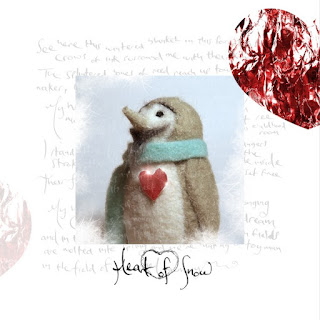
I started with the simple penguin object photo (actually a felt penguin, I added the beard myself with my felting needles). I added some white frosty snowflakes around its periphery. On its own it looked a little plain. This would be fine for one page, but I had the idea of one page for each song, and many like that were rather empty looking. I experimented with the plain lyrics, but, again, all plain text looked a little too messy, the text is legible, but only just, and many pages of it looked a little simplistic, spidery, and a bit of a waste of colour printing.

I tried combining the two in many ways, and tried adding type-written text, but the typed letters looked far too rigid and 'digital', like a cheap greetings card. So, I layered the text in many ways, colourful, plain, inverted, complex. Some obscuring or interacting with the image inside, some not.

I made up images for each song, taken from the tree photos:

Then added the faint grey text, as seen here, which seemed to balance the look, though not as utilitarian, as the words are sometimes impossible to read, so designed more as a feeling with hints of truth, or things to discover. I created the red heart to add something to the white edge and added these.

So this is the stage so far, but there are many options. I like the ink drawn writing. In aesthetics, its often about feeling, the balance of order and chaos; is there too much order? Too much chaos? Just as I like the production style of Bowie's favoured producer, Tony Visconti, I like the visual style of his latter-era album artist, Jonathan Barnbrook.

Productivity aside I'm generally in a slow and tired mood, but I must remind myself that steadily doing things for hours is what work is, so if this is being done, then this is a measure of productivity rather than quantities of outcomes. Most of the actual music is complete. I burned a test CD of Heart of Snow today for a final audio-proof. There is always a lot to do on each album now; this art, Spotify Canvases, lyric reading videos, the essential filing and music administration, and none of that is publicity or any of that which I have always disliked and shun.